ICT concept · PD array
Balanced Price Range (BPR)
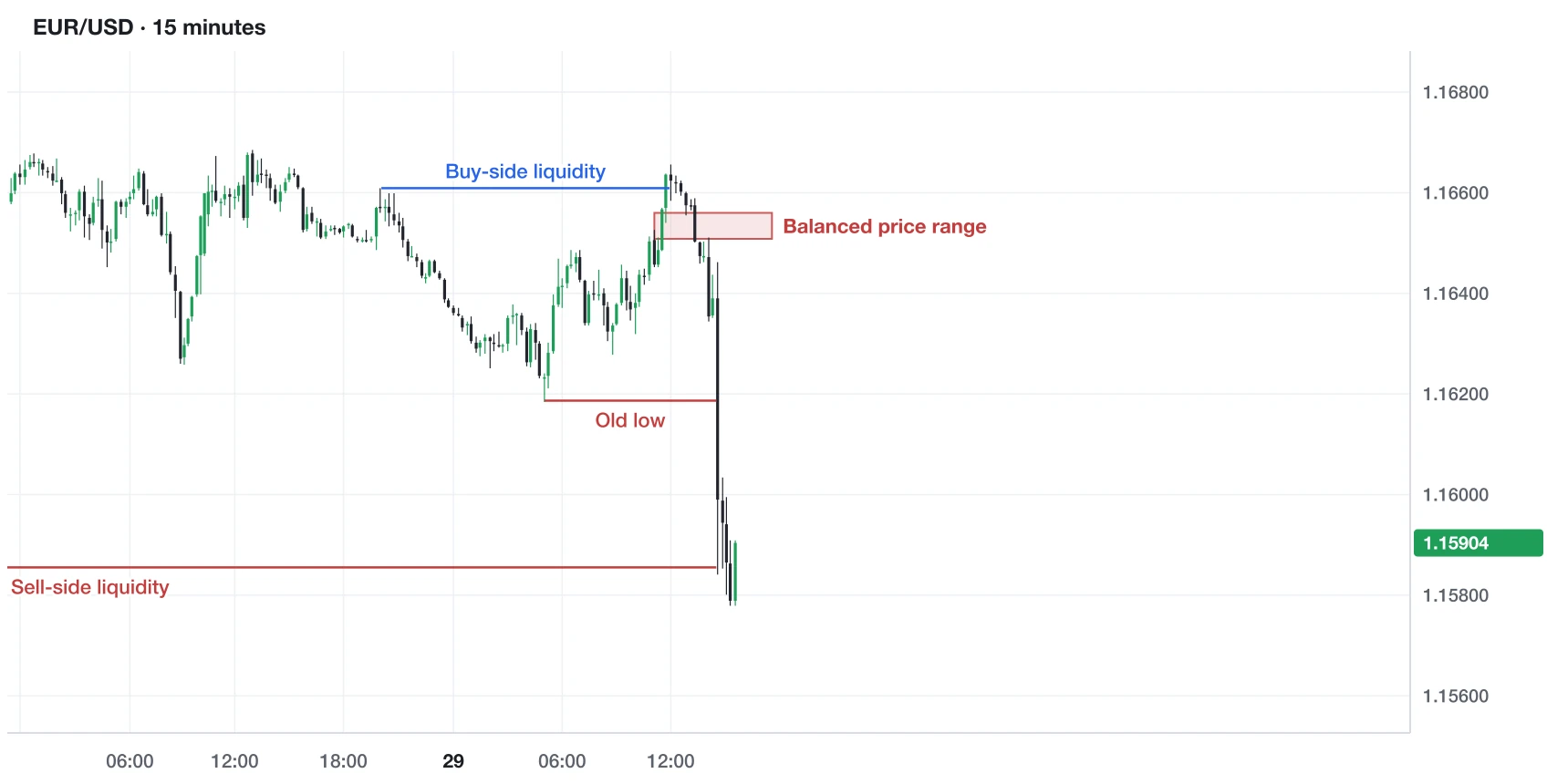
A range price has been delivered through in both directions, where a bullish gap and a bearish gap overlap: price treats it like a wall.
Updated
What is a Balanced Price Range?
When price moves through a range one way and then straight back the other way, it leaves two opposing imbalances on top of each other. The overlap is a balanced price range: both sides have been offered there. Once price leaves it, it tends to act as strong support or resistance.
How to spot it on a chart
- Look for a sharp move up and a sharp move down through the same prices, close in time.
- The overlap of the two gaps (the bullish one and the bearish one) is the range.
- It counts once price has passed through it both ways and left.
How traders use it for an entry
- Above a balanced price range, buy as price pulls back into it; below one, sell as price rallies into it.
- Stop beyond the range (or past its last quarter for a tighter one).
- It works best combined with a shift in direction and a time window you trade.
What cancels it
- A body closes all the way through the range.
- A new gap that forms inside it breaks away from nothing: don't treat it as a fresh gap.
Common mistakes
- Using the whole of both gaps: only the part where they overlap counts.
- Trading it before price has left it: it counts once price has gone through it both ways and moved away.
- Treating a new gap that forms inside it as a fresh one.
In ICT's own words
Short excerpts from the lectures where ICT teaches it, each linked to the moment he says it.
“a balanced price range is where price delivers on the downside and the upside.”
“Now once it trades through it again, this range is now balanced because we went down, up, down through it.”
Track the Balanced Price Range in your journal
daqverse is a trading journal for ICT traders. It does not find the pattern for you; it keeps a record of the trades you take from it, so you can see whether it works for you.
- Every daqverse account starts with the Balanced Price Range as a concept, with this explanation, ICT's quotes and the charts, in Flowstate's Concepts. Rename it or spell it your way; it stays one concept.
- When you log a trade, pick it as a confluence at the entry step, so the trade records what you entered from.
- Tag a Playbook model with it, and Concept Mastery shows how the trades taken on that model went.
- Link it from a study note with [[Balanced Price Range]] or a #tag: the concept's page lists every note that mentions it.
Questions
How is a balanced price range different from a fair value gap?
A fair value gap was delivered one way only. A balanced price range is where a bullish and a bearish gap overlap, so that range has been offered in both directions; once price leaves it, it tends to act as a strong wall.
Related concepts
Fair Value Gap (FVG)
Three candles where the middle one moved so fast that the first and third never overlap: a gap price was delivered through on one side only.Inversion Fair Value Gap (IFVG)
A fair value gap that failed: price closed through it, and now uses it from the other side to push the opposite way.Volume Imbalance (VI)
Two candles whose bodies don't touch, even though their wicks do: a small gap between the bodies that price tends to come back to.Opening Gap (NWOG · NDOG)
The gap between a session's close and the next open: the week's (NWOG, Friday close to Sunday open) and the day's (NDOG, 5 p.m. close to 6 p.m. open).Liquidity Void
A stretch price ran through so fast, in long one-sided candles, that almost no trading happened there: a vacuum price wants to come back and fill.
ICT (The Inner Circle Trader) teaches these concepts in his lectures. daqverse is a trading journal and is not affiliated with ICT: the explanations are our own words, and the quotes are short excerpts linked to the lecture.
Concepts to study, not trading signals; the charts are past price. Not financial advice. Risk disclaimer.
Keep exploring
- ICT trading journalA trading journal for ICT traders: every trade tagged with its New York kill zone and macro, a daily plan, a live session view and reviews by setup.
- ICT kill zone clockThe ICT kill zones and macros in New York time, live: which window is open now, the next one with a countdown, and the times in your own time zone.
- Flowstate study notesFlowstate keeps your trading study notes: a daily note beside each day's trades, linked pages and the concepts you are learning.
Journal your next Balanced Price Range trade
daqverse is in early access: request a place and we email you an invite. Already invited? Log in.