Crude oil futures trading journal
A crude oil futures trading journal for CL and MCL traders
daqverse is a trading journal built for ICT and prop-firm futures traders: it tags every trade with its New York kill zone and tracks each prop account's drawdown rules. Crude oil futures are priced in dollars a barrel and move in one-cent ticks: on CL, the 1,000-barrel contract, a cent is $10 and a dollar is $1,000; on MCL, the 100-barrel micro, a cent is $1. Crude also changes contract every month, so a journal for it has to get the dollars right and keep track of which contract a trade was in.
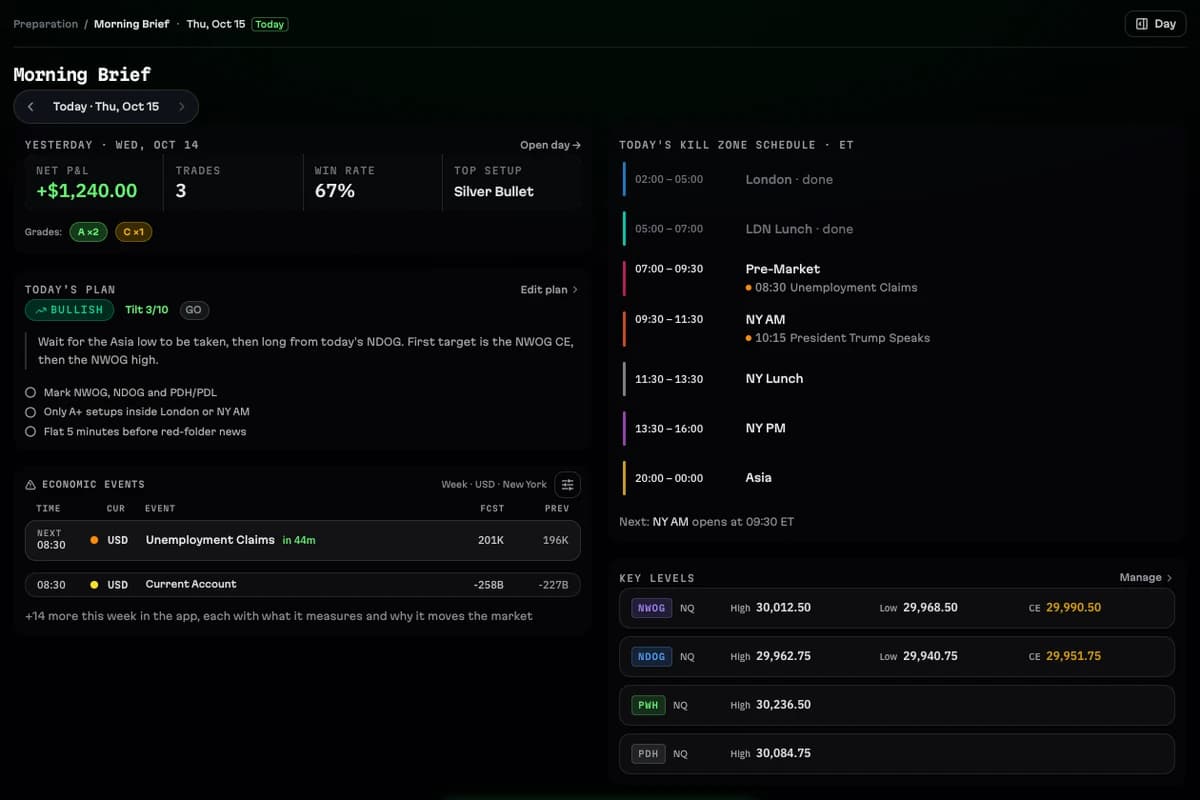
daqverse works the barrels, ticks, R and dollars out for every CL and MCL trade, dates it on the CME trading day, tags it with its New York kill zone and macro, and lists the week's US releases, the Wednesday inventory report among them, in the Morning Brief.
Updated
Past results don't guarantee future results; sample data is illustrative. Risk disclaimer.
Who it is for
CL and MCL traders
The full contract or the micro, the continuous contract or a named month, single entries or scaled positions.
Traders around the inventory report
You want the Wednesday release and your trades around it in the same record.
Futures traders with more than one market
Crude sits beside your index or gold trades, each with its own contract values.
Prop firm futures traders
Your crude trades count toward the account's floor, daily loss limit and payout days.
What the journal does for crude
Every part below is in the app today. The pictures show daqverse's sample data; crude trades use the same screens with CL's and MCL's own values.
Barrels and cent ticks in dollars
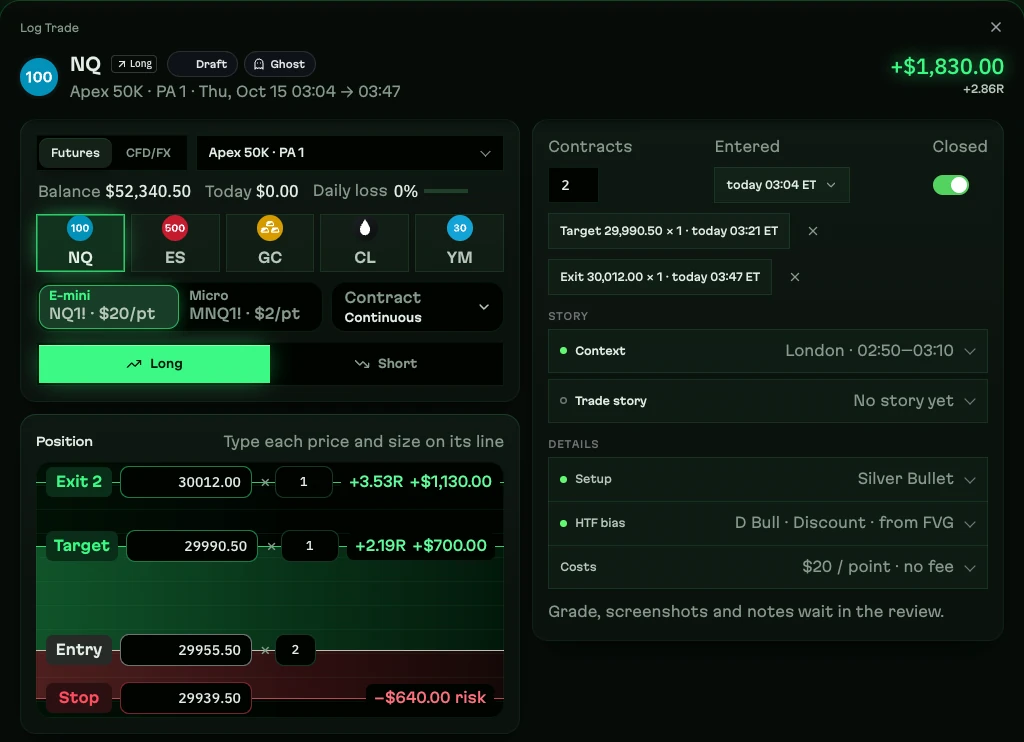
CL is 1,000 barrels, so its $0.01 tick is $10 and a one-dollar move is $1,000 a contract; MCL is 100 barrels, $1 a tick and $100 a dollar. On the ticket, entry, stop, target and each exit sit on one price ladder with their own size, and R and dollars update as you type.
Fees come off the result, scaled exits stay separate lines, and if you prefer the P&L your broker reported, the ticket keeps that instead.
Futures position size calculator
Monthly contracts with their last trading days
Crude lists a contract for every month, and each stops trading before the month begins: CL three business days before the 25th of the month before (four when the 25th is not a business day), MCL a day earlier. daqverse lists the dated contracts with their last trading day, so a trade logged as CLZ2026 or MCLF2027 is saved under the contract it was really in, and the continuous CL1! still counts as CL.
The inventory report in the calendar
The Morning Brief carries the week's US economic calendar in your time zone, with the next high-impact release counted down. Crude Oil Inventories, the weekly change in US commercial crude stocks from the EIA, usually lands at 10:30 New York time on Wednesday, and its note in the app says what it measures.
A trade taken into the release sits next to it in the day's record, so you can read your Wednesdays apart from your other days.
Kill zones, macros and the CME day
Each crude trade is tagged from its entry time with its New York kill zone and its ICT macro window, and dated on the CME session day: after 18:00 New York time a trade belongs to the next day's session. Analytics can filter to crude alone or compare it with your other markets.
Prop account limits beside the trades
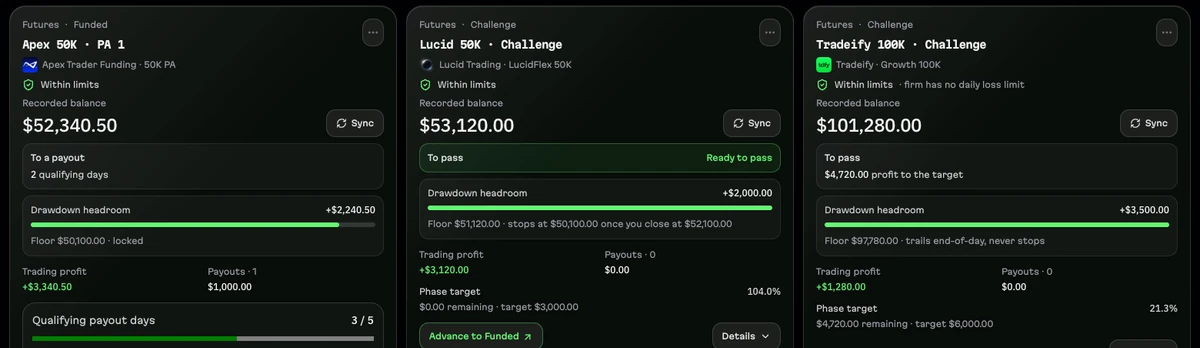
With CL's cent worth $10, a wide stop can use much of a daily loss limit. On a prop account each crude trade counts toward the floor, daily loss limit and consistency rule, and the room left updates as you log; it is an estimate from your trades, not your firm's figure.
Past results don't guarantee future results; sample data is illustrative. Risk disclaimer.
A crude session in daqverse
Step 1
Before New York
The Morning Brief lists the day's releases; on Wednesdays, the inventory report.
Step 2
In the session
Live Session shows the kill zone, the next macro and each account's daily loss room.
Step 3
After each trade
Log CL or MCL with its contract month: the cents become dollars.
Step 4
After the close
Grade the trades, or import the Tradovate file and review that.
Step 5
Each month
Move to the next contract; your statistics keep the trades as crude.
What daqverse does not do
- daqverse has no live price feed and no broker connection: trades come from the Quick Log or an exported file.
- The Key Levels board and its level feed cover NQ and MNQ only; crude levels are not sent to the app.
- Nothing here is financial advice, and no session or setup is promised to make money.
Questions
What is a tick worth on CL and MCL?
Crude Oil futures (CL) move in $0.01 ticks worth $10 per contract, so a one-dollar move is $1,000. Micro WTI Crude Oil (MCL) has the same one-cent tick, worth $1, so a dollar is $100. daqverse uses these values for every crude trade.
When does the crude inventory report come out?
The EIA's weekly Crude Oil Inventories release usually comes at 10:30 New York time on Wednesday. It appears in the Morning Brief's economic calendar for the week, in your time zone.
How does daqverse handle crude's monthly contracts?
You can log against the continuous CL1! or a named month such as CLZ2026. The app lists each month with its last trading day, and every crude contract counts as CL (or MCL for the micro) in your statistics.
Does daqverse connect to my broker or my prop firm?
No. There is no live broker connection and no market data feed. Trades come in through the Quick Log right after the close, a Tradovate CSV for futures accounts, or a statement file (MT4, MT5, cTrader, Match-Trader and others) for forex and CFD accounts. Statement files are read in your browser and never uploaded.
Are the account numbers exact?
No. Balances, floors and the room left are estimates worked out from the trades you log and the rules you enter, not live broker equity or your firm's official figures. Your firm's own dashboard is the one that counts.
How do I get access, and what does it cost?
daqverse is in early access. You request a place with your email address (Gmail, Outlook, iCloud, Yahoo, Proton or another major provider) and what you trade, and invites go out by email in small groups. It costs nothing while you are in the beta and no card is asked for. Paid plans are not open yet; when they open, everyone with a beta account gets 5 days of free Pro, and 35% off their first payment if they choose a plan in those 5 days.
Journal your next crude trade in daqverse
daqverse is in early access: request a place and we email you an invite. Already invited? Log in.
Keep exploring
- Gold futures trading journalJournal gold futures, GC and MGC: $10 and $1 ticks worked out for you, every trade on the CME day, tagged by kill zone, the US news calendar beside it.
- NQ futures trading journalJournal NQ and MNQ trades with points, ticks and dollars worked out, New York sessions and kill zones on every trade, and key levels for the Nasdaq.
- Prop firm trading journalA journal for prop firm futures traders: each account's drawdown floor, daily loss limit and payout rules tracked from your own trades, as you set them.
- Futures position size calculatorHow many contracts for your risk: enter dollars at risk and your stop in points or ticks for NQ, MNQ, ES, MES, YM, GC or CL. Free, no sign-up.
- ICT kill zone clockThe ICT kill zones and macros in New York time, live: which window is open now, the next one with a countdown, and the times in your own time zone.