ICT concept · PD array
Consequent Encroachment (CE)
The middle (50%) of a gap, a wick or any range: the level that shows whether price respects it.
Also written as CE (Midpoint) · midpoint
Updated
What is a Consequent Encroachment?
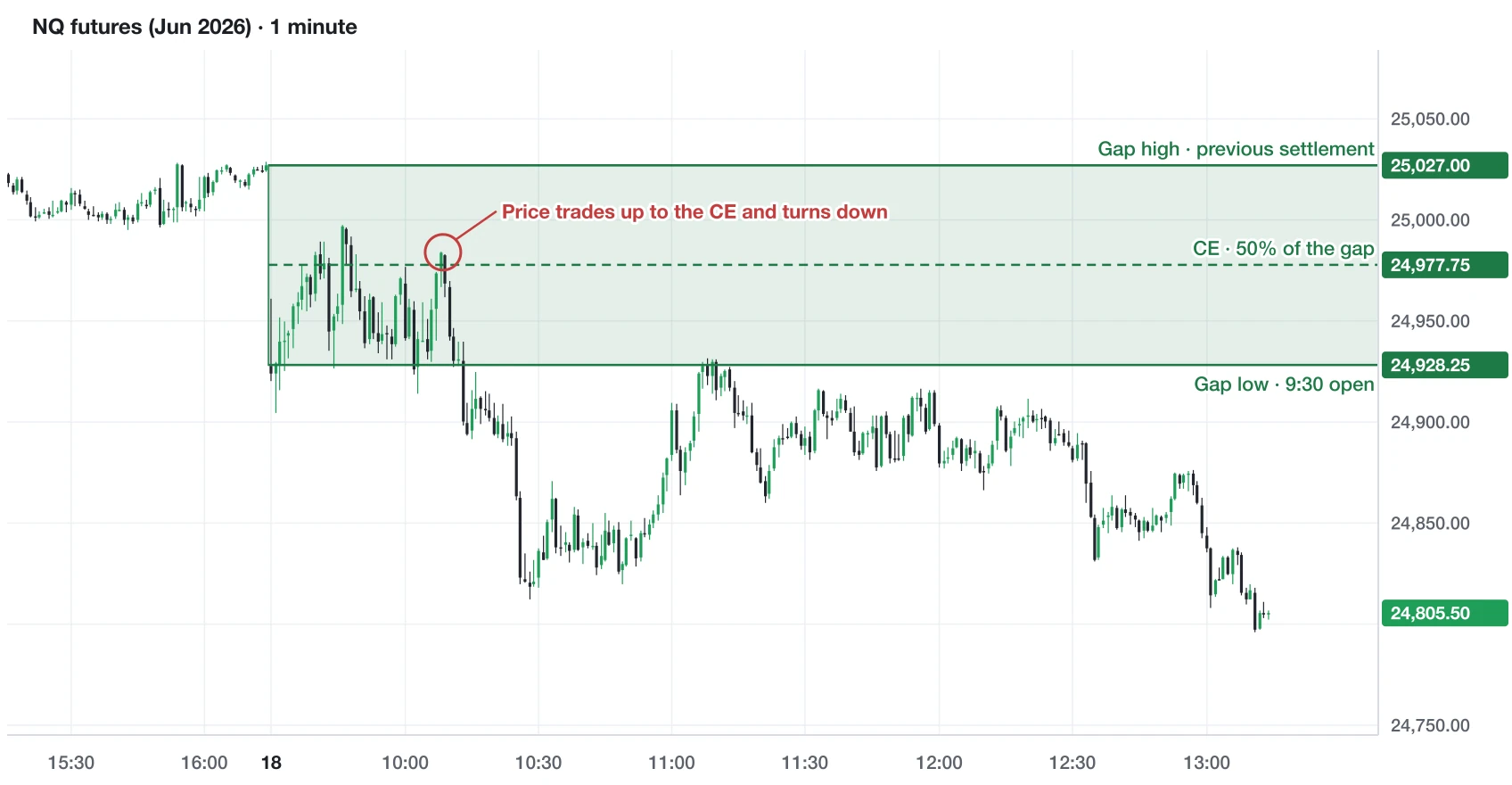
Split a fair value gap, a wick or an imbalance in half: that midpoint is its consequent encroachment (CE). Price reacting at the CE, and bodies staying on the right side of it, shows the gap is being respected. For an order block the same 50% line is called the mean threshold.
How to spot it on a chart
- Mark the high and low of the gap (or wick, or range).
- Draw the line halfway between them: that is the CE.
- Watch where candle bodies close relative to it, not where wicks reach.
How traders use it for an entry
- In a wide gap, an entry at the CE gives a better price than its edge.
- Stops are placed beyond the CE of the array you trade from, not inside it.
- A wick's CE is a common place to take partial profit.
What cancels it
- If you are bullish, you don't want bodies closing below the CE (above it, if bearish).
- In a very wide gap the CE may never be reached: don't wait for a fill that doesn't come.
Common mistakes
- Watching wicks instead of bodies. A wick through the CE is fine; bodies closing beyond it are the warning.
- Waiting for the CE in a very wide gap that never gets there.
- Putting the stop at the CE itself instead of beyond it.
In ICT's own words
Short excerpts from the lectures where ICT teaches it, each linked to the moment he says it.
“consequent encroachment, which is the midpoint of a gap”
“it goes to the midpoint of that — I teach that as consequent encroachment.”
Track the Consequent Encroachment in your journal
daqverse is a trading journal for ICT traders. It does not find the pattern for you; it keeps a record of the trades you take from it, so you can see whether it works for you.
- Every daqverse account starts with the Consequent Encroachment as a concept, with this explanation, ICT's quotes and the charts, in Flowstate's Concepts. Rename it or spell it your way; it stays one concept.
- When you log a trade, pick it as a confluence at the entry step, so the trade records what you entered from.
- Tag a Playbook model with it, and Concept Mastery shows how the trades taken on that model went.
- Link it from a study note with [[Consequent Encroachment]] or a #tag: the concept's page lists every note that mentions it.
- daqverse's NQ key levels list each gap as three rows, its high, its CE and its low, so the middle is marked for you. See Key Levels.
Questions
What is the difference between consequent encroachment and the mean threshold?
Both are a 50% line. Consequent encroachment is the middle of a gap or a wick; the mean threshold is the middle of an order block's candle.
How do you find the consequent encroachment of a gap?
Mark the gap's high and low and draw a line halfway between them. For a wick, use the wick's tip and the candle body it hangs from.
Related concepts
Fair Value Gap (FVG)
Three candles where the middle one moved so fast that the first and third never overlap: a gap price was delivered through on one side only.Order Block (OB)
The last opposite-colour candle before price displaces away: the price where the big orders behind that move sat.Rejection Block
A swing high or low made of long wicks: the wicks ran the stops, and the block is the area between the wick and the candle bodies.Opening Gap (NWOG · NDOG)
The gap between a session's close and the next open: the week's (NWOG, Friday close to Sunday open) and the day's (NDOG, 5 p.m. close to 6 p.m. open).Optimal Trade Entry (OTE)
Buying a pullback (or selling a rally) into the 62%–79% zone of the last impulse swing, with 70.5% as the sweet spot.
ICT (The Inner Circle Trader) teaches these concepts in his lectures. daqverse is a trading journal and is not affiliated with ICT: the explanations are our own words, and the quotes are short excerpts linked to the lecture.
Concepts to study, not trading signals; the charts are past price. Not financial advice. Risk disclaimer.
Keep exploring
- ICT trading journalA trading journal for ICT traders: every trade tagged with its New York kill zone and macro, a daily plan, a live session view and reviews by setup.
- ICT kill zone clockThe ICT kill zones and macros in New York time, live: which window is open now, the next one with a countdown, and the times in your own time zone.
- Flowstate study notesFlowstate keeps your trading study notes: a daily note beside each day's trades, linked pages and the concepts you are learning.
Journal your next Consequent Encroachment trade
daqverse is in early access: request a place and we email you an invite. Already invited? Log in.