ICT concept · PD array
Propulsion Block
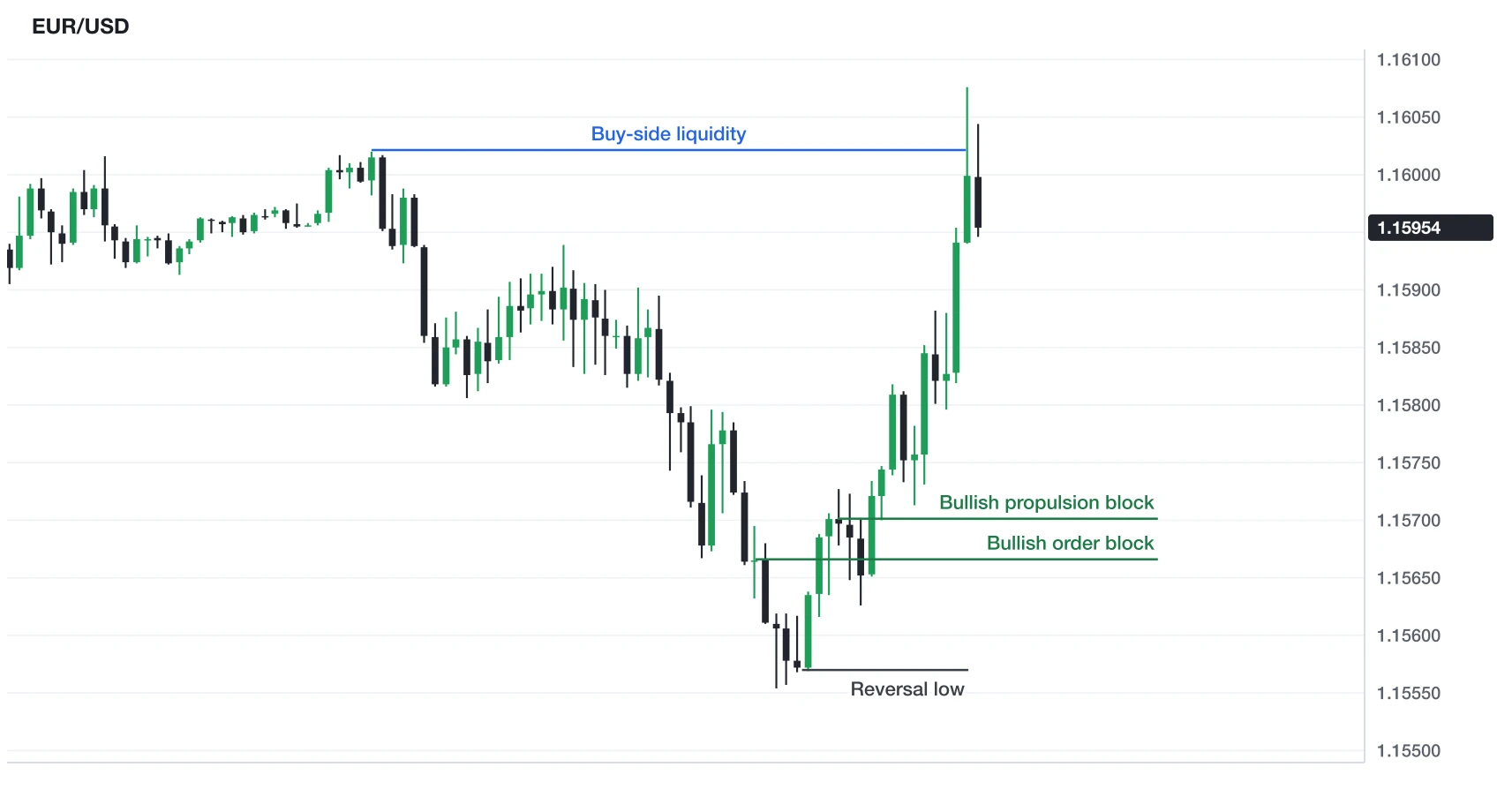
An order block inside an order block: a candle that dug into the first block and then held, becoming the launch point for the next leg.
Also written as propulsion candle
Updated
What is a Propulsion Block?
After a bullish order block forms, price may come back down with another down-close candle that trades into the first block. If that candle holds, it becomes the propulsion block: the new, tighter support for the move higher. The bearish version is the mirror, an up-close candle digging into a bearish order block.
How to spot it on a chart
- Find a first order block, then a later candle of the same kind that trades into it.
- That second candle must not close beyond the first block's middle (mean threshold).
- It is the second stage of an accumulation (or distribution): the move is refuelling, not reversing.
How traders use it for an entry
- Buy as price trades back down to the top of a bullish propulsion candle (sell into a bearish one).
- Use a tight stop: below the propulsion candle, or below its middle.
- Expect a fast move away: it often only touches the top of the candle before it goes.
What cancels it
- A close below the propulsion candle's middle (above it, for a bearish one).
- A body through the parent order block's middle.
Common mistakes
- Looking for one with no order block in place: a propulsion block only exists inside a block that already formed.
- Giving it a wide stop. It is a tight level, and a close beyond its middle means it failed.
- Waiting for a deep pullback: price often only touches the top of the candle before it moves.
In ICT's own words
Short excerpts from the lectures where ICT teaches it, each linked to the moment he says it.
“a propulsion block is a candle or bar that is previously traded down into a down candle or bullish order block, and takes over the role of price support for higher price movement.”
“this candle also becomes a propulsion candle, which is another order block that's bullish, that creates a higher high.”
Track the Propulsion Block in your journal
daqverse is a trading journal for ICT traders. It does not find the pattern for you; it keeps a record of the trades you take from it, so you can see whether it works for you.
- Every daqverse account starts with the Propulsion Block as a concept, with this explanation, ICT's quotes and the charts, in Flowstate's Concepts. Rename it or spell it your way; it stays one concept.
- When you log a trade, pick it as a confluence at the entry step, so the trade records what you entered from.
- Tag a Playbook model with it, and Concept Mastery shows how the trades taken on that model went.
- Link it from a study note with [[Propulsion Block]] or a #tag: the concept's page lists every note that mentions it.
Questions
What is the difference between an order block and a propulsion block?
A propulsion block is a second order block that forms inside the first: a later candle that trades into the first block and holds. It is the tighter, later level the next leg starts from.
Related concepts
Order Block (OB)
The last opposite-colour candle before price displaces away: the price where the big orders behind that move sat.Mitigation Block
Like a breaker, but without the stop run: a lower high (or higher low) fails, and the candle where buyers got trapped becomes resistance (or support).Breaker Block
An order block that failed after a stop run: once price breaks through it, it flips and supports (or resists) the new move.
ICT (The Inner Circle Trader) teaches these concepts in his lectures. daqverse is a trading journal and is not affiliated with ICT: the explanations are our own words, and the quotes are short excerpts linked to the lecture.
Concepts to study, not trading signals; the charts are past price. Not financial advice. Risk disclaimer.
Keep exploring
- ICT trading journalA trading journal for ICT traders: every trade tagged with its New York kill zone and macro, a daily plan, a live session view and reviews by setup.
- ICT kill zone clockThe ICT kill zones and macros in New York time, live: which window is open now, the next one with a countdown, and the times in your own time zone.
- Flowstate study notesFlowstate keeps your trading study notes: a daily note beside each day's trades, linked pages and the concepts you are learning.
Journal your next Propulsion Block trade
daqverse is in early access: request a place and we email you an invite. Already invited? Log in.