ICT concept · Structure and delivery
Market Structure Shift (MSS)
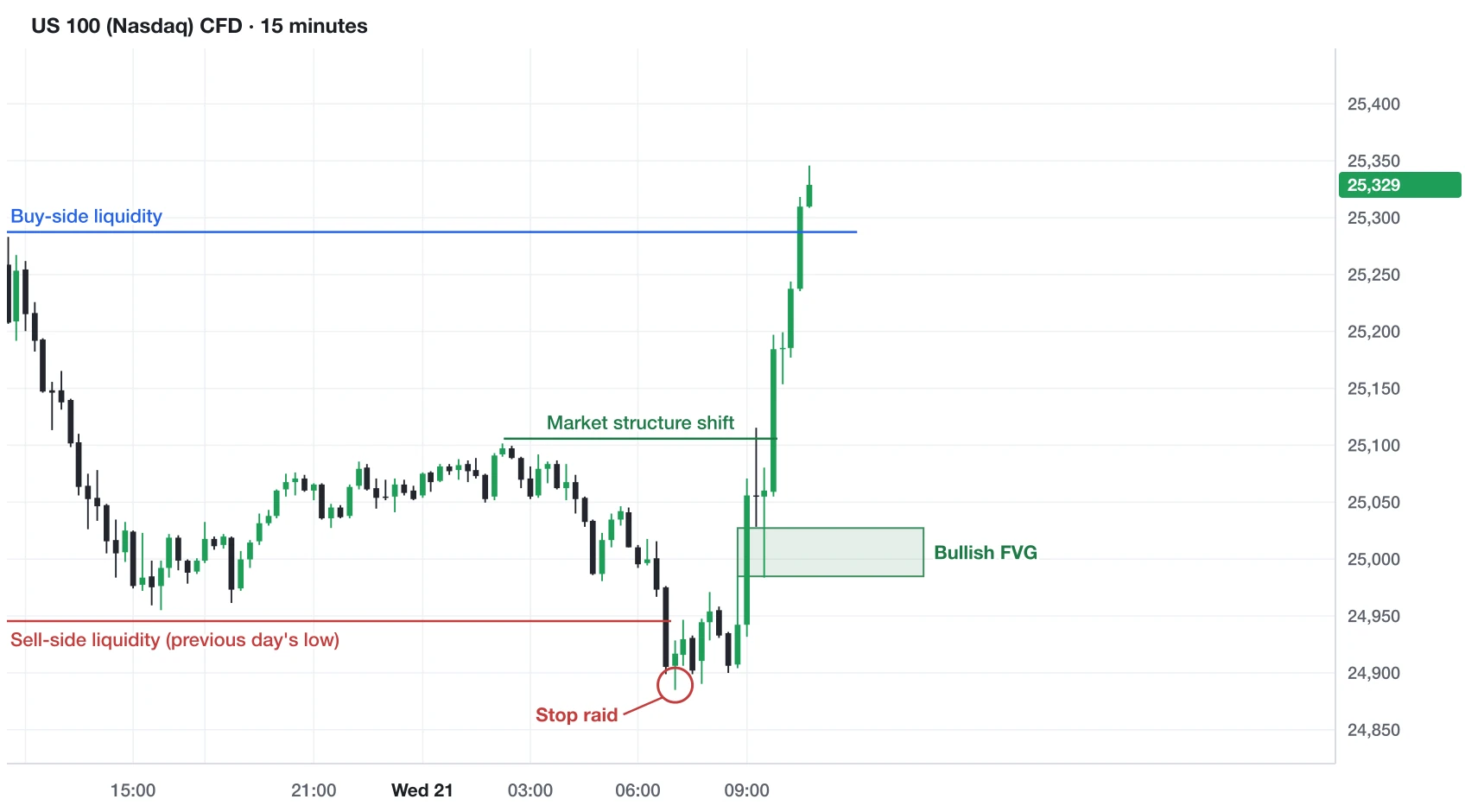
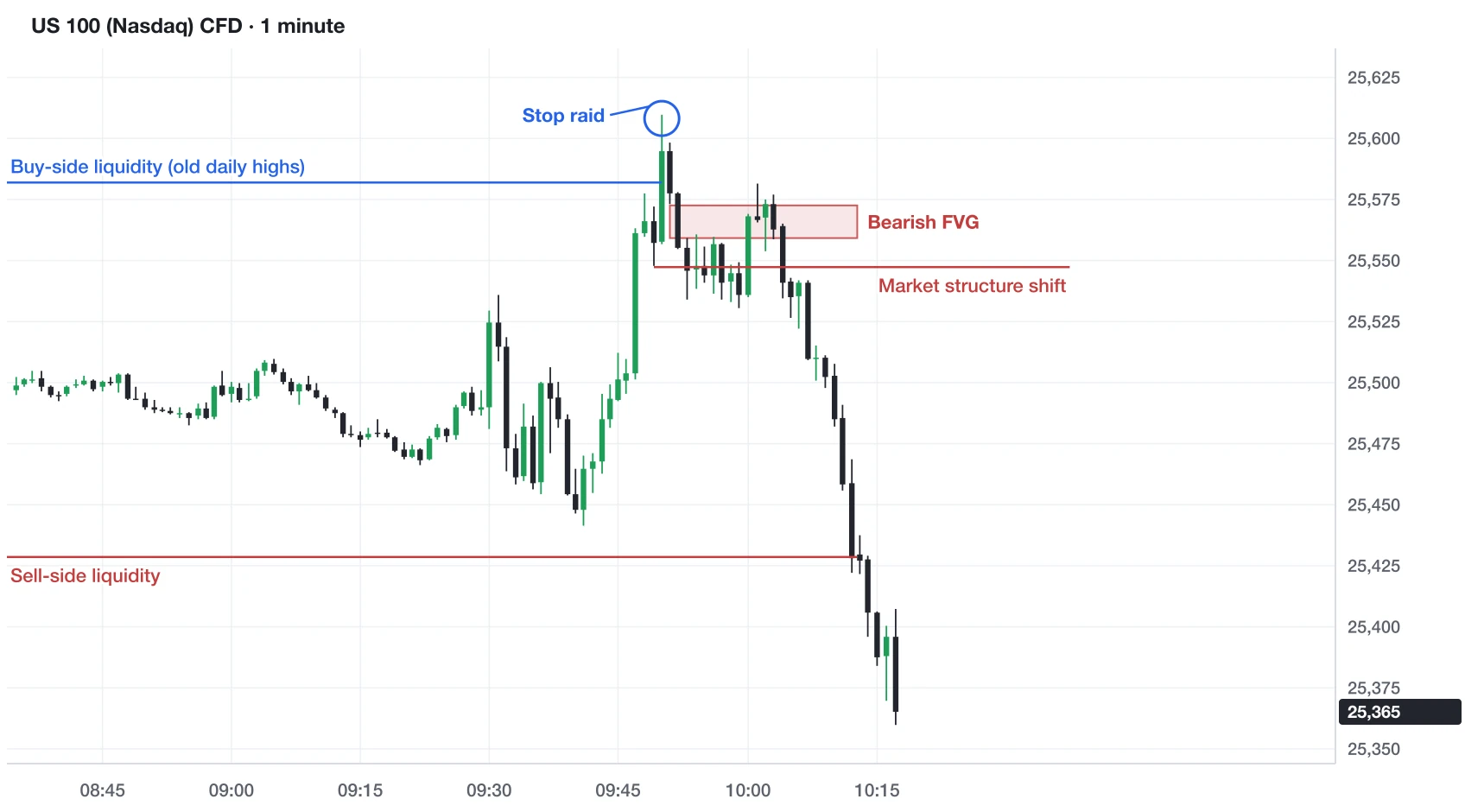
After a sweep of liquidity, price breaks the last short-term swing in the other direction, ideally with displacement: a sign the short-term direction changed.
Also written as Shift in Market Structure
Updated
What is a Market Structure Shift?
In a move down, each short-term high sits below the one before it. When price takes sell-side liquidity and then breaks above the last short-term high with a strong move, the market has shifted: it is now likely to draw higher, at least in the short term. A bearish shift is the mirror: buy-side liquidity is taken, then the last short-term low breaks. ICT calls it a shift, not a break: a short-term change of direction, read inside the higher-timeframe story.
How to spot it on a chart
- First a run on liquidity: an old high or low is taken.
- Find the short-term swing that started that run: the last swing high before a run on sell stops, the last swing low before a run on buy stops.
- The shift is price moving through that swing with displacement; the move often leaves a fair value gap.
- It counts most at a higher-timeframe PD array, inside a kill zone and in the direction of your bias.
How traders use it for an entry
- Wait for the retrace after the shift, into the fair value gap or order block the break left.
- Put the stop beyond the extreme of the run that came before the shift.
- Aim for the liquidity the new direction points to: the old high above, or the old low below.
What cancels it
- Price trades back beyond the extreme of the run: the shift failed.
- A shift against a strong higher-timeframe draw is often only a pause before the bigger move resumes.
Common mistakes
- Calling one big engulfing candle a shift: what makes it is a swing broken after liquidity was taken.
- Buying the break itself instead of waiting for the retrace into what it left.
- Putting the stop in or at the fair value gap the shift left: it belongs beyond the swing.
In ICT's own words
Short excerpts from the lectures where ICT teaches it, each linked to the moment he says it.
“short-term high taken out, that's a shift in market structure”
“A market structure shift is just a short-term change in market sentiment and it will deliver on a short-term basis.”
Track the Market Structure Shift in your journal
daqverse is a trading journal for ICT traders. It does not find the pattern for you; it keeps a record of the trades you take from it, so you can see whether it works for you.
- When you log a trade, type Market Structure Shift as a confluence: it becomes one of your concepts, ready to pick on every trade after, so each trade records the idea behind it.
- Write [[Market Structure Shift]] or a #tag in a Flowstate note: the concept gets a page listing every note that mentions it, with one tap to add it to your concepts.
- Tag a Playbook model with it, and Concept Mastery shows how the trades taken on that model went.
Questions
What is the difference between a market structure shift and a break of structure?
Traders use break of structure (BOS) for a break in the direction of the trend, a continuation. A market structure shift is a break against the recent move, after liquidity was taken: the first sign of a reversal.
Does a market structure shift need a candle close beyond the swing?
ICT has said it does not: price trading through the short-term swing with displacement is the shift. Many traders still wait for a body close to filter out weak breaks.
Related concepts
Displacement
A fast, strong move in one direction, usually with large candles, that often leaves fair value gaps behind: the sign big money stepped in.Liquidity Sweep
A quick move through an old high or low that sets off the stop orders resting there, after which price reverses.Change in State of Delivery (CISD)
Price crosses the opening price of the candles that delivered it into a key level: the delivery has switched direction.Fair Value Gap (FVG)
Three candles where the middle one moved so fast that the first and third never overlap: a gap price was delivered through on one side only.Breaker Block
An order block that failed after a stop run: once price breaks through it, it flips and supports (or resists) the new move.SMT Divergence (SMT)
Two related markets disagree: one makes a new high or low and the other does not (NQ and ES, for example). ICT reads it as a warning the move may fail.
ICT (The Inner Circle Trader) teaches these concepts in his lectures. daqverse is a trading journal and is not affiliated with ICT: the explanations are our own words, and the quotes are short excerpts linked to the lecture.
Concepts to study, not trading signals; the charts are past price. Not financial advice. Risk disclaimer.
Keep exploring
- ICT trading journalA trading journal for ICT traders: every trade tagged with its New York kill zone and macro, a daily plan, a live session view and reviews by setup.
- ICT kill zone clockThe ICT kill zones and macros in New York time, live: which window is open now, the next one with a countdown, and the times in your own time zone.
- Flowstate study notesFlowstate keeps your trading study notes: a daily note beside each day's trades, linked pages and the concepts you are learning.
Journal your next Market Structure Shift trade
daqverse is in early access: request a place and we email you an invite. Already invited? Log in.