ICT concept · Liquidity and the run on stops
SMT Divergence (SMT)
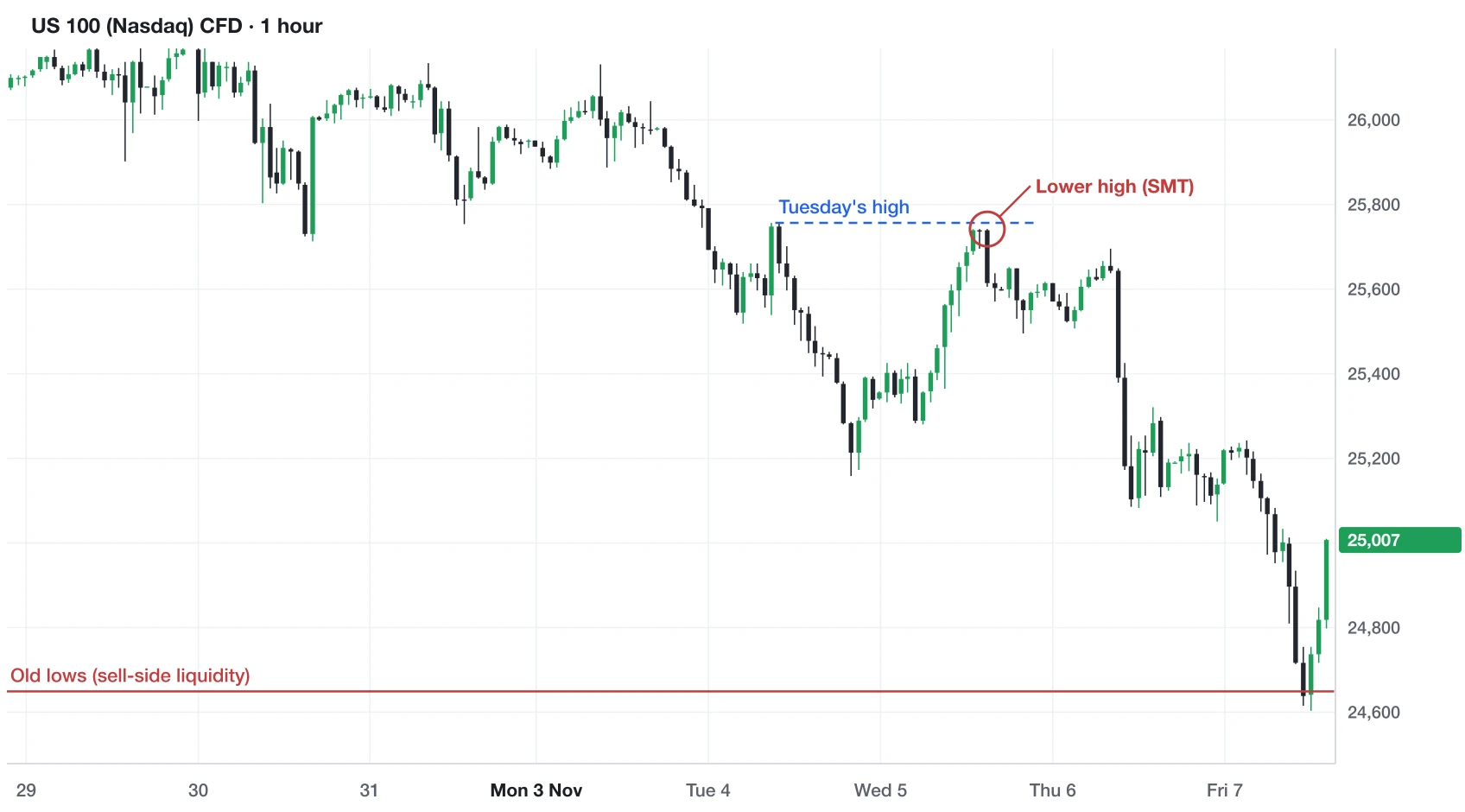
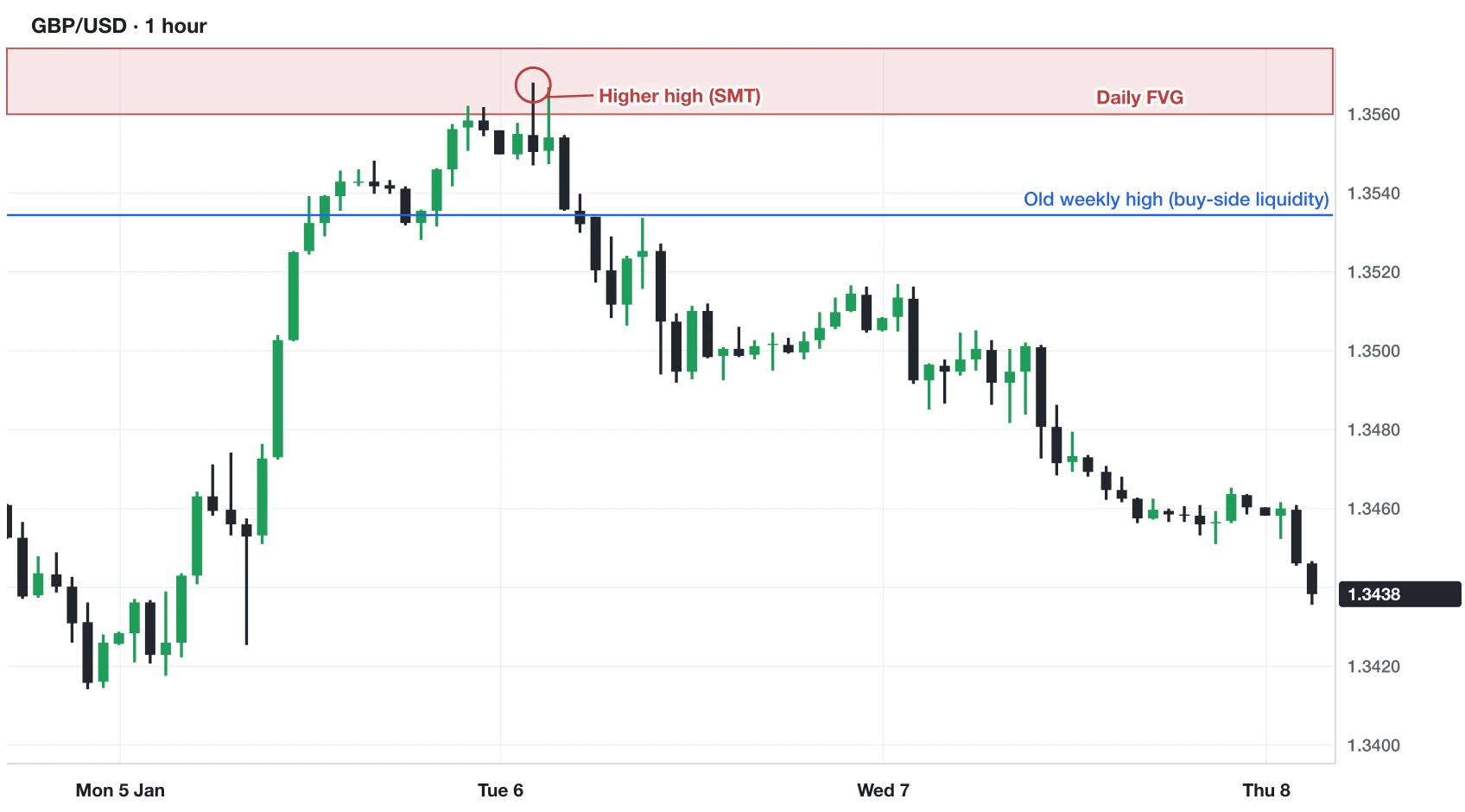
Two related markets disagree: one makes a new high or low and the other does not (NQ and ES, for example). ICT reads it as a warning the move may fail.
Also written as Smart Money Technique
Updated
What is a SMT Divergence?
SMT stands for smart money technique. Closely correlated markets, such as NQ, ES and YM, or EUR/USD and GBP/USD, usually make their highs and lows together. When one makes a higher high while the other makes a lower high, or one a lower low while the other holds a higher low, the correlation has cracked: the market that failed is showing the strength or weakness the other one hides. ICT uses it to confirm a turn he already expects, not as a signal on its own.
How to spot it on a chart
- Put two correlated charts side by side on the same timeframe: NQ and ES is the usual pair for index futures.
- At a run on liquidity, compare their swing highs (or lows): does one take its old high while the other doesn't?
- Bearish SMT: one makes a higher high, the other a lower high. Bullish SMT: one makes a lower low, the other a higher low.
- It matters most at a key level you were already watching, inside a kill zone.
How traders use it for an entry
- Use it to confirm a reversal setup you already have, such as a sweep followed by a market structure shift.
- ICT's own use: short the market that made the lower high.
- Put the stop beyond the swept high (or low) and aim for the liquidity on the other side.
What cancels it
- The lagging market catches up and makes its own higher high (or lower low): the divergence is gone.
- If you have to squint to see it, there is no divergence.
Common mistakes
- Using SMT as a timing tool. It confirms an idea; it does not tell you when to enter.
- Comparing markets that are not closely correlated, or charts on different timeframes.
- Trading it on its own, away from any key level.
In ICT's own words
Short excerpts from the lectures where ICT teaches it, each linked to the moment he says it.
“Now SMT stands for smart money technique, and we're going to be looking for a divergence between closely correlated or inversely correlated assets.”
“SMT is not a timing tool, it's a confirmation tool, okay? It confirms something that you were already expecting anyway.”
Track the SMT Divergence in your journal
daqverse is a trading journal for ICT traders. It does not find the pattern for you; it keeps a record of the trades you take from it, so you can see whether it works for you.
- When you log a trade, type SMT Divergence as a confluence: it becomes one of your concepts, ready to pick on every trade after, so each trade records the idea behind it.
- Write [[SMT Divergence]] or a #tag in a Flowstate note: the concept gets a page listing every note that mentions it, with one tap to add it to your concepts.
- Tag a Playbook model with it, and Concept Mastery shows how the trades taken on that model went.
Questions
What does SMT stand for in ICT?
Smart money technique: a divergence between correlated markets at a high or low, read as a sign that the move is running out.
Which markets are used for SMT divergence?
Index futures against each other (NQ, ES, YM), currency pairs against each other (EUR/USD and GBP/USD) or against the dollar index, and bonds of different maturities.
Related concepts
Liquidity Sweep
A quick move through an old high or low that sets off the stop orders resting there, after which price reverses.Market Structure Shift (MSS)
After a sweep of liquidity, price breaks the last short-term swing in the other direction, ideally with displacement: a sign the short-term direction changed.Draw on Liquidity (DOL)
Where price seems to be heading next: a pool of stops above an old high or below an old low, or an open gap. A working assumption, not a promise.Judas Swing
An early false move near an open that runs the wrong way, trips traders into the wrong side, then reverses into the day's real direction.
ICT (The Inner Circle Trader) teaches these concepts in his lectures. daqverse is a trading journal and is not affiliated with ICT: the explanations are our own words, and the quotes are short excerpts linked to the lecture.
Concepts to study, not trading signals; the charts are past price. Not financial advice. Risk disclaimer.
Keep exploring
- ICT trading journalA trading journal for ICT traders: every trade tagged with its New York kill zone and macro, a daily plan, a live session view and reviews by setup.
- ICT kill zone clockThe ICT kill zones and macros in New York time, live: which window is open now, the next one with a countdown, and the times in your own time zone.
- Flowstate study notesFlowstate keeps your trading study notes: a daily note beside each day's trades, linked pages and the concepts you are learning.
Journal your next SMT Divergence trade
daqverse is in early access: request a place and we email you an invite. Already invited? Log in.