ICT concept · Time and the daily cycle
Power of Three (PO3)
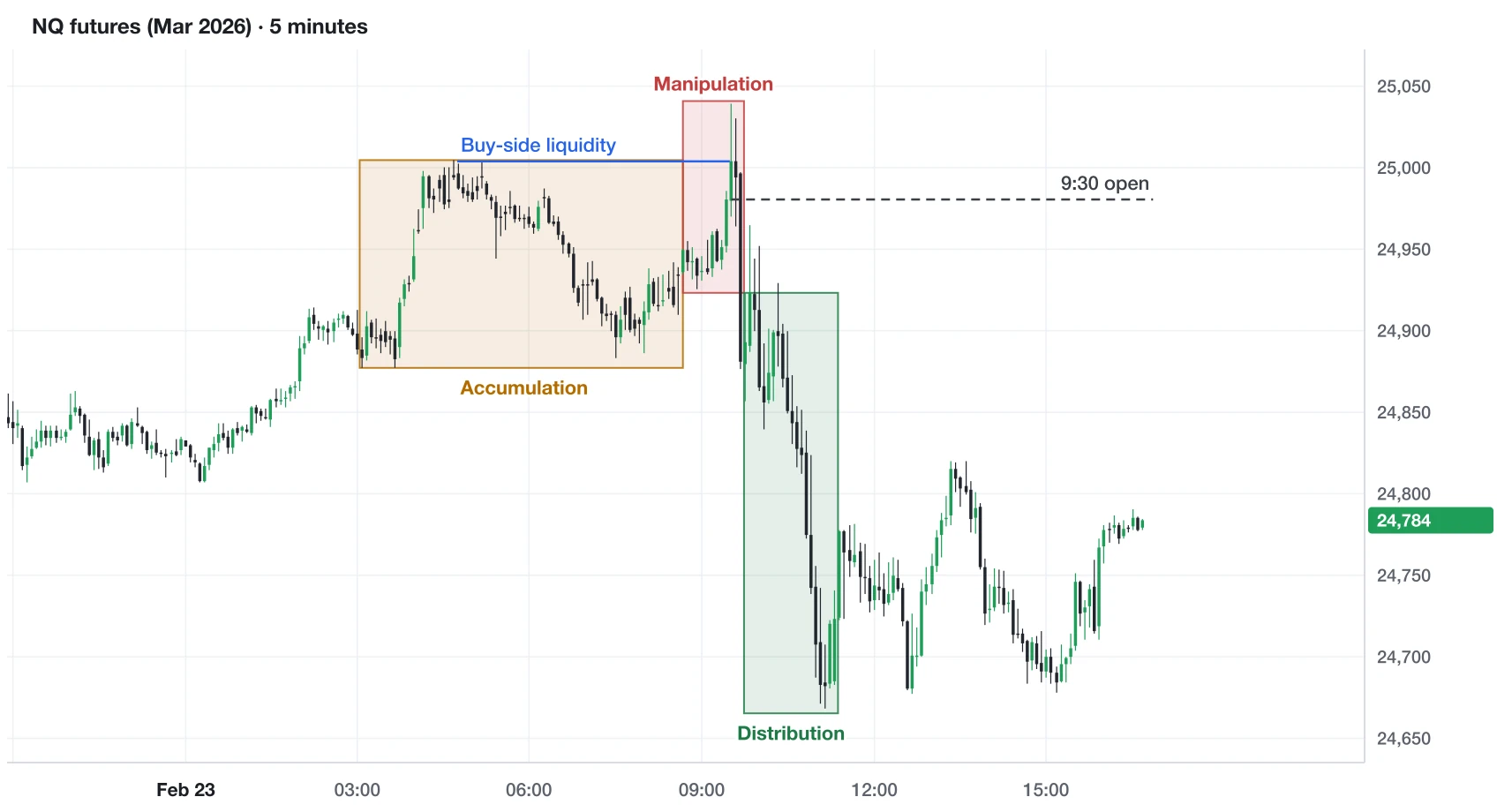
Each candle is built in three steps: accumulation near the open, a false move the wrong way (manipulation), then the real move (distribution).
Also written as AMD · Accumulation, Manipulation, Distribution
Updated
What is a Power of Three?
ICT's power of three describes how a period's candle forms: the open, a move against the period's direction, then the expansion that makes its close. On a bullish day price opens, drops below the opening price to run sell stops while longs are filled, then rallies and closes near the high. A bearish day is the mirror. It applies to any period: the day, a session, the week.
How to spot it on a chart
- Mark the period's opening price; for the day ICT often uses midnight New York.
- Accumulation: price holds in a range near the open.
- Manipulation: a quick move the opposite way from your bias that takes an old high or low (the Judas swing).
- Distribution: the expansion in your bias's direction that carries price far from the open into the close.
How traders use it for an entry
- On a bullish day, buy below the opening price during the manipulation, at a discount PD array; on a bearish day, sell above it.
- Put the stop beyond the manipulation's extreme.
- Hold toward liquidity in your bias's direction: the period should close near its high (bullish) or low (bearish).
What cancels it
- Price expands the wrong way from the open and keeps going: the manipulation was the real move.
- Price never leaves the open: there is no distribution that period.
Common mistakes
- Treating it as a forecast. It frames where to buy or sell against the open once you have a bias.
- Buying above the opening price on a bullish day: the edge is buying during the move below it.
- Mixing up the order: the manipulation comes before the real move, not after it.
In ICT's own words
Short excerpts from the lectures where ICT teaches it, each linked to the moment he says it.
“Power of three is the concept I teach as it relates to the daily open, high, low, close bar.”
“Power of Three stands for accumulation, distribution, and manipulation, okay, that's what Power of Three is.”
Track the Power of Three in your journal
daqverse is a trading journal for ICT traders. It does not find the pattern for you; it keeps a record of the trades you take from it, so you can see whether it works for you.
- When you log a trade, type Power of Three as a confluence: it becomes one of your concepts, ready to pick on every trade after, so each trade records the idea behind it.
- Write [[Power of Three]] or a #tag in a Flowstate note: the concept gets a page listing every note that mentions it, with one tap to add it to your concepts.
- Tag a Playbook model with it, and Concept Mastery shows how the trades taken on that model went.
- daqverse's Key Levels include the midnight and weekly opening prices, the lines the power of three is measured from. See Key Levels.
Questions
What does AMD stand for in ICT?
Accumulation, manipulation, distribution: the three steps of the power of three. Positions build near the open, a false move runs stops the wrong way, then the real move delivers price to its target.
Which opening price does the power of three use?
The opening price of the period you trade: midnight New York for ICT's daily view, the session's open for a session, Sunday's open for the week.
Related concepts
Judas Swing
An early false move near an open that runs the wrong way, trips traders into the wrong side, then reverses into the day's real direction.Liquidity Sweep
A quick move through an old high or low that sets off the stop orders resting there, after which price reverses.Draw on Liquidity (DOL)
Where price seems to be heading next: a pool of stops above an old high or below an old low, or an open gap. A working assumption, not a promise.Premium and Discount
Split the current range at its middle, equilibrium: above it price is at a premium, where ICT looks to sell; below it at a discount, where he looks to buy.
ICT (The Inner Circle Trader) teaches these concepts in his lectures. daqverse is a trading journal and is not affiliated with ICT: the explanations are our own words, and the quotes are short excerpts linked to the lecture.
Concepts to study, not trading signals; the charts are past price. Not financial advice. Risk disclaimer.
Keep exploring
- ICT trading journalA trading journal for ICT traders: every trade tagged with its New York kill zone and macro, a daily plan, a live session view and reviews by setup.
- ICT kill zone clockThe ICT kill zones and macros in New York time, live: which window is open now, the next one with a countdown, and the times in your own time zone.
- Flowstate study notesFlowstate keeps your trading study notes: a daily note beside each day's trades, linked pages and the concepts you are learning.
Journal your next Power of Three trade
daqverse is in early access: request a place and we email you an invite. Already invited? Log in.