ICT concept · PD array
Suspension Block
A single candle with a volume imbalance at its top and at its bottom: it acts like a fair value gap, even if old wicks cross it.
Updated
What is a Suspension Block?
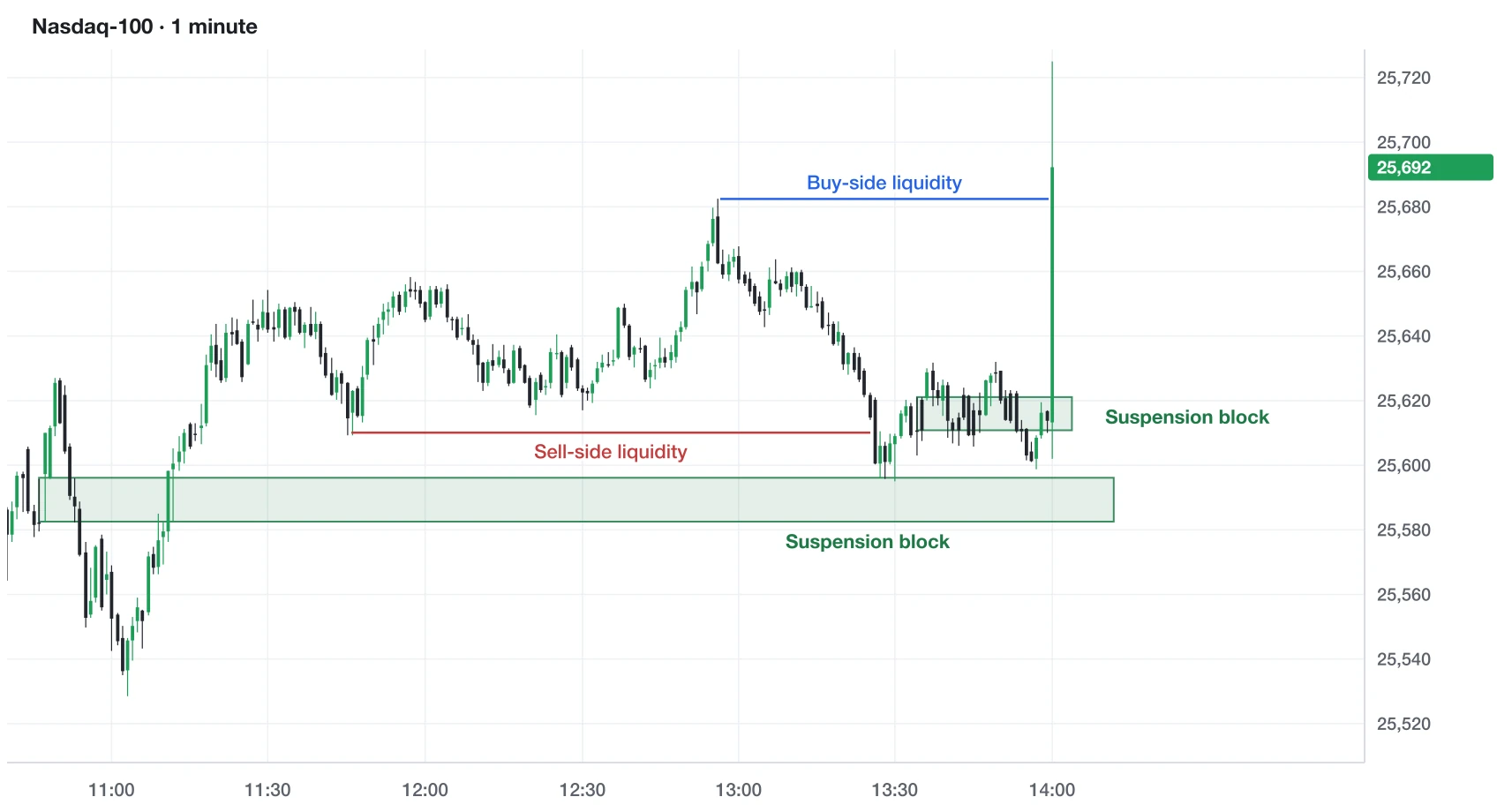
A suspension block is one displacement candle whose body is separated from the candles on both sides: a volume imbalance above and below it. Even when wicks from the left overlap it, it behaves like a fair value gap, and its middle is the level to watch.
How to spot it on a chart
- Find a candle whose body doesn't touch the bodies before and after it (the gaps can be tiny).
- Mark it from the imbalance at its top to the imbalance at its bottom.
- Ignore wicks from earlier candles that already crossed it.
How traders use it for an entry
- Trade it like a fair value gap: an entry at or near its middle, stop at the candle's open.
- Aim for the nearest liquidity, such as relative equal highs or lows.
What cancels it
- Bodies trading back through it against your direction: the line in the sand is lost.
Common mistakes
- Expecting a visible gap: the imbalances above and below the body can be tiny, and earlier wicks may cross it.
- Skipping the body test: if its body touches the bodies on either side, it is not a suspension block.
In ICT's own words
Short excerpts from the lectures where ICT teaches it, each linked to the moment he says it.
“whenever you have one single candle that has a volume imbalance to the low and a volume imbalance to the high, that is going to act just like a fair value gap.”
“Suspension blocks are isolated candlesticks that really represent a point at which the algorithm will come back into it”
Track the Suspension Block in your journal
daqverse is a trading journal for ICT traders. It does not find the pattern for you; it keeps a record of the trades you take from it, so you can see whether it works for you.
- Every daqverse account starts with the Suspension Block as a concept, with this explanation, ICT's quotes and the charts, in Flowstate's Concepts. Rename it or spell it your way; it stays one concept.
- When you log a trade, pick it as a confluence at the entry step, so the trade records what you entered from.
- Tag a Playbook model with it, and Concept Mastery shows how the trades taken on that model went.
- Link it from a study note with [[Suspension Block]] or a #tag: the concept's page lists every note that mentions it.
Questions
How is a suspension block different from a fair value gap?
A fair value gap is the space between the first and third candles' wicks. A suspension block is a single candle whose body is cut off from the bodies on both sides by volume imbalances; it trades like a gap even when old wicks overlap it.
Related concepts
Volume Imbalance (VI)
Two candles whose bodies don't touch, even though their wicks do: a small gap between the bodies that price tends to come back to.Fair Value Gap (FVG)
Three candles where the middle one moved so fast that the first and third never overlap: a gap price was delivered through on one side only.Consequent Encroachment (CE)
The middle (50%) of a gap, a wick or any range: the level that shows whether price respects it.
ICT (The Inner Circle Trader) teaches these concepts in his lectures. daqverse is a trading journal and is not affiliated with ICT: the explanations are our own words, and the quotes are short excerpts linked to the lecture.
Concepts to study, not trading signals; the charts are past price. Not financial advice. Risk disclaimer.
Keep exploring
- ICT trading journalA trading journal for ICT traders: every trade tagged with its New York kill zone and macro, a daily plan, a live session view and reviews by setup.
- ICT kill zone clockThe ICT kill zones and macros in New York time, live: which window is open now, the next one with a countdown, and the times in your own time zone.
- Flowstate study notesFlowstate keeps your trading study notes: a daily note beside each day's trades, linked pages and the concepts you are learning.
Journal your next Suspension Block trade
daqverse is in early access: request a place and we email you an invite. Already invited? Log in.